Artificial intelligence has taken the world by storm and found itself in nearly every aspect of our lives. While the technology is still new, it is being developed rapidly to reshape industries globally to improve efficiency. In order to stay ahead of the curve and meet patient expectations, it is vital to understand how these changes affect your dental practice.
Diagnostics and Treatment Plans
AI has been implemented in every step of dental treatment, beginning with a consultation. Remote consultations have grown in popularity, known as ‘telehealth’, but with AI technology, doctors no longer need to even have a remote call with a patient. Specific AIs have been trained to conduct a patient consultation virtually.
AI analysis in teledentistry has proven to be 79x faster than human analysis. This efficiency allows for a more streamlined treatment process as it eliminates the need for the patient to come into the practice for a consultation, saving both parties time. The process is quite simple and is something of the future.
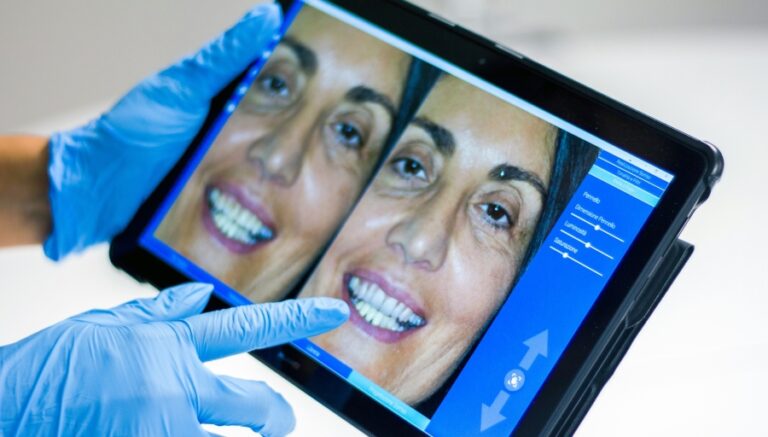
Image-based AI screenings allow patients to submit images of their mouth and teeth and a trained AI can analyze and identify signs of early decay, demineralisation, gum disease, oral lesions, and even oral cancers.
From this, AI triages patients based on its analysis of the images, meaning it can even minimize unnecessary visits by determining if an issue is even present. Dentists always check and verify the AI’s results before moving forward, but by eliminating appointment consultations, it still frees up a significant amount of time for the dentist.
It is also able to create personalized treatment plans for the patient and assists with appointment scheduling to successfully map out the timeline of treatment.
A Real World Example
A patient has been experiencing gum discomfort, so they log onto their teledentistry app and submit photos of their teeth and gums. The AI will prompt them to take well-lit and clear pictures from specific angles.
Then, the AI will analyze and identify visual factors like erythema, swelling, and gum recession. The AI will note there is a high probability of localized gingivitis transitioning into periodontitis and will triage the urgency of the case.
The findings will be synced with the patient’s existing digital chart including past treatments and self-reported medical history. In some cases, the AI can use past x-rays to measure alveolar bone loss to the millimeter, or overlay colored heatmaps to highlight areas of inflammation and plaque build-up.
A dentist will then review all the information the AI has collected and its suggested diagnosis. They can confirm the AI’s findings and officially diagnose the patient with stage II periodontitis.
The AI will then use clinical guidelines and the patient’s case severity to draft a treatment plan. It suggests scaling and root planing and uses the patient’s lifestyle data to customise a hygiene regimen for them to follow at home like antimicrobial rinses and a pressure-tracking electric toothbrush.
A patient report will also be generated without any confusing medical jargon and even provides an interactive visual of their mouth to show where inflammation and bone loss is and explains why they need treatment. The dentist reviews the plan and report and is able to make tweaks before approving and sending it directly to the patient’s teledentistry app.
The AI takes it a step further by searching through local offices and their schedules to determine when the patient can be seen for their deep cleaning. It will notify the patient of potential appointment options and schedule them. After the appointment, patients can share their progress with the practice by continuing to upload images into the app and the AI will track their gum healing.
How Can a Practice Implement AI Technology?
Some AI software like Pearl or Overjet can be downloaded to analyze 2D radiographs and intraoral images. Telehealth platforms like MouthWatch or Dentally Vision can be used for remote screening, video consultations, and simple check-ins.
It may also be helpful to provide AI chatbots directly on your practice’s website to handle appointment scheduling, 24/7 enquiries, and even triage dental emergencies.
Always conduct thorough research before implementing any AI tools into your practice by ensuring it follows the ADA’s standards on data collection, privacy and safety, and clinical use.
If your practice chooses to use AI, all patients must be informed on what data is being collected and how it is used. Patient consent is vital for the use of teledentisty and remote data transmission. All teledentistry and AI platforms must comply with HIPAA regulations and need to be properly encrypted using cloud-based management.
Patients use of AI
It is also important to remember that AI is accessible to anyone, and 1 in 3 adults reported to have used AI to answer their health questions in 2025. Patients are essentially having AI-powered consultations before they even contact any practice.
While this may make it easier to implement AI into your practice, it also means that patients are more likely to have detailed knowledge of their symptoms and treatments. They are also likely to search for practices that will best treat their symptoms using AI, meaning it is vital to have as much information about the services your practice provides on your website to ensure it is accessible to AI.
This is precisely where Vector 44 excels. Specially crafted landing pages provide the information both patients and AI are searching for. We combine this with enhanced digital ads systems for dental practices and DSOs, providing measurable new patient growth, cleaner tracking, and tighter control over wasted spend. If your practice or group is seeing rising costs, inconsistent lead quality, or unclear performance from paid search, we can help you identify what is happening and build a better acquisition system. Contact us here: https://v44.uk/contact/
Researched and written by:
